Take the paper off your walls.
Hospitals run on taped paper, fragile email chains, and tribal knowledge. Relay is the always-on operational layer your unit already glances at — one wall, every phone, always current.
90 seconds, end to end.
A short tour of authoring a card, watching it land on the wall, and scanning it onto a phone — the whole loop.
Want a live walkthrough sooner? Book a 20-minute demo — we'll record it for you.
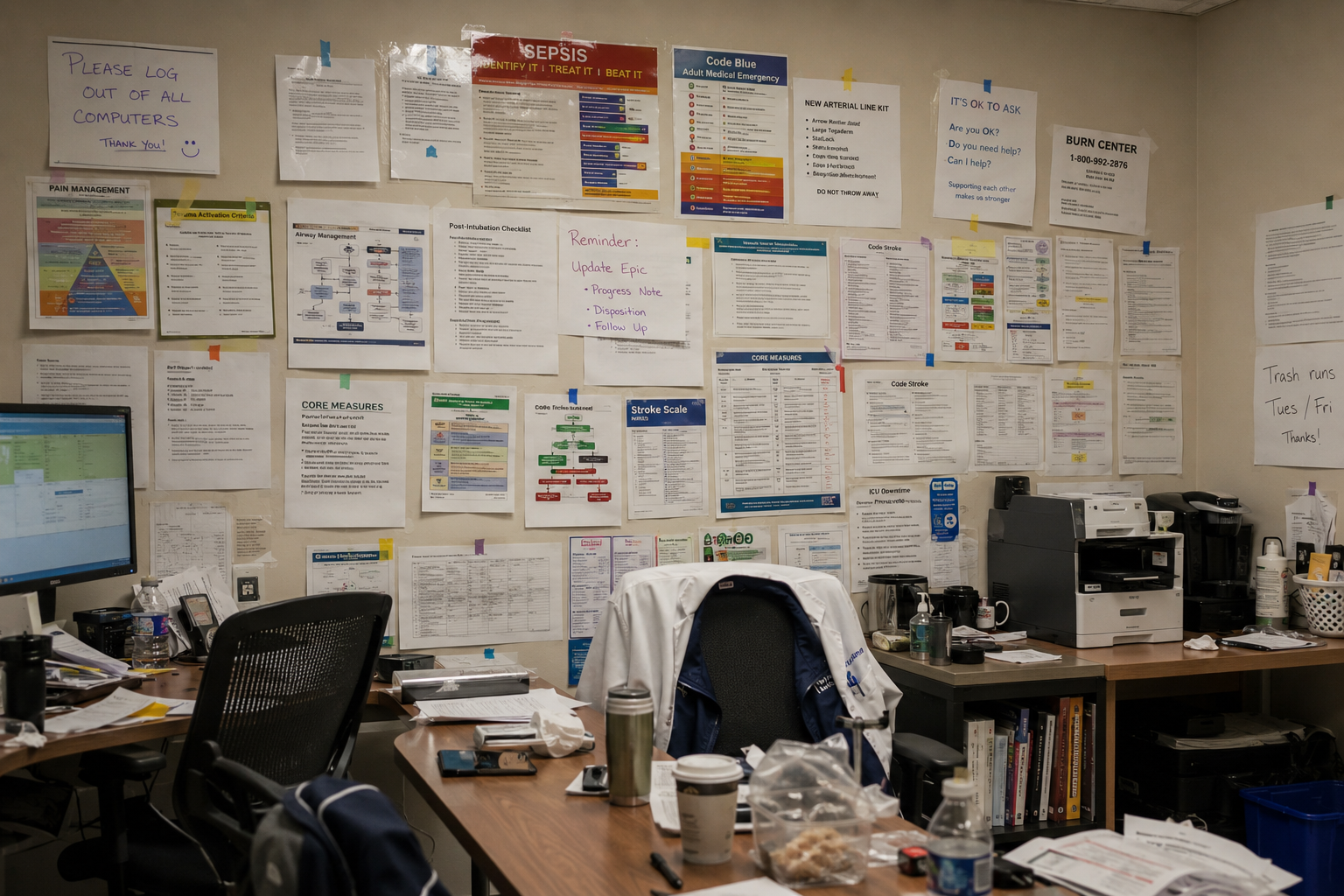
Every unit has one. Nobody trusts it.
The corkboard by the nurses' station. The sepsis protocol taped over the sepsis protocol from two years ago. The binder no one opens. The whiteboard a resident wiped last Tuesday because they needed space. Paper is what hospitals reach for — and it fails the same way every time.
No version. No date. No author. Probably v2 — but v4 went up by email last Thursday.
Night shift swears they didn't. Day shift thought they posted it. No way to tell who actually read it.
The night attendant texts at 3am. The protocol lives on a shared drive she can't reach from home.
Not with digital signage. Not with another dashboard. With a shared cognitive surface.
The wall is shared. The phone is yours.
One surface for the team. One for each clinician. Same data underneath. No shared keyboards, no awkward touchscreens, no room microphones — just a screen everyone trusts and a phone everyone already has.
In the line of sight, not in an inbox.
Awareness that lives where the team already looks — the nurses' station, the trauma bay, the workroom — beats awareness that has to be searched, opened, or unsubscribed from.
What's true right now, not last week.
Workflow updates, expiring policies, today's huddle topic, who's on call. Operational truth — not clinical chart data, not a dashboard you have to log into.
A shared mental model for the shift.
Everyone walking through the unit — incoming nurse, night attending, traveler on her first day — leaves with the same picture of what changed and what matters. That's shared cognition, not signage.
Ambient. Glanceable. Trusted.
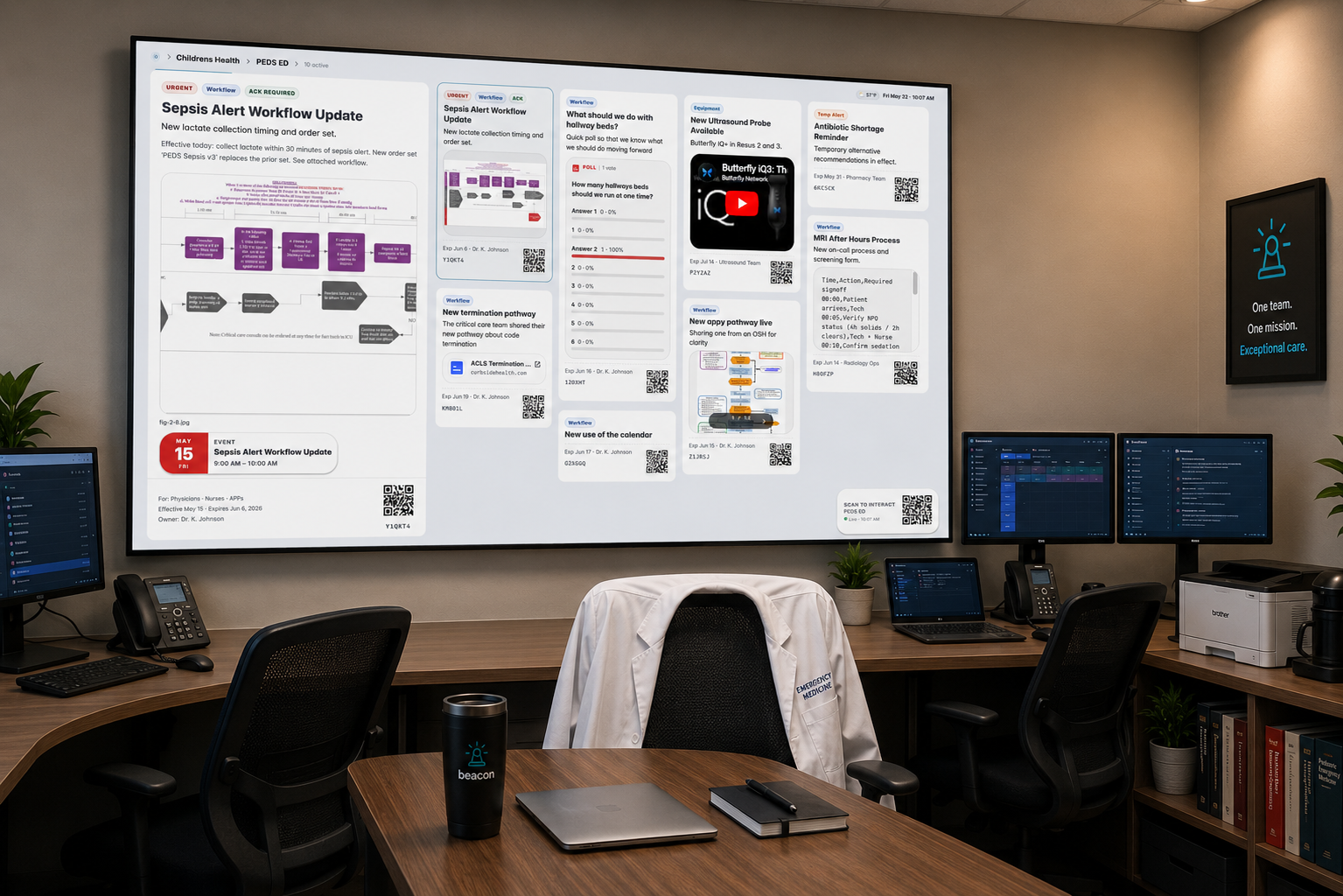
Mount one screen where your team already looks. Relay shows what changed, what's urgent, and what's coming — passively, continuously, in a calm layout that reads from across the room.
- – Shared cognition for the whole shift
- – Auto light / dark by time of day
- – A live pulse so anyone walking by knows it's current
- – Any browser-capable TV — no proprietary hardware
Personal. Authenticated. Fast.
Scan the wall to interact. Take a card with you. Acknowledge what you've read. Start a huddle from across the unit. The phone is the input layer — the wall is the output.
- – See → scan → act. No login, no navigation, no search.
- – A "since my last shift" feed that highlights only what's new.
- – Bookmark a card and read the PDF at home at 3am.
- – Start or join a workspace's huddle without scanning, if needed.
The differentiator isn't the screen. It's the contextual operational cognition Relay delivers ambiently — without alert fatigue or workflow friction.
One source of truth
Edit a protocol once. Every wall in every unit and every clinician's phone updates instantly. No re-printing. No stale version drift. No "is this the right one?"
Always-on, always-current
A live screen that shows what matters now — urgent alerts, expiring policies, scheduled huddles. Day shift, night shift, weekend resident: same picture, freshly updated.
Audit-ready by default
Every change tracked. Every acknowledgment logged. When the Joint Commission asks "how do you know staff saw this?" — you have an answer.
Three surfaces. One ambient layer.
Relay ships as three connected boards — one for the steady state, one for the huddle, one for the crisis. Same authoring tools, same data layer. Most units start with one and layer in the others.
Ops Board
The wall at the nurses' station. Featured rotation, masonry of active cards, every card scannable to a phone. Light during day shift, dark at night.
See it on the wallHuddle Board
The same wall, filtered to a single huddle topic with a countdown. Charge nurse handoff, physician signout, code debrief — wall reverts to Ops Board when the timer ends.
Run a huddleDecision Board
A full-screen pathway aid for the trauma bay or resus room. One pathway edge-to-edge, step-through hands-free, readable from the head of the bed.
See decision supportThree pieces. No printer required.
Mount a screen
Any TV with a browser becomes a wall display. Relay rotates featured cards, shows live huddles, and updates in real time. No app to install.
Post a card
Admins write a short card: title, summary, audience, expiration. Attach a PDF, a video, a poll, a calendar event. Publish — or schedule for shift change.
Scan to take it with you
Every card has a QR code. Clinicians scan it on the way out — the card is on their phone, with the source PDF, before they finish their next charting cycle.
The moment a charge nurse says "check Relay"
instead of "I think there was an email…"
That's when you've stopped fighting the paper wall — and started running on shared cognition. A 20-minute demo, with cards from your unit. No deck.
Book a demo